
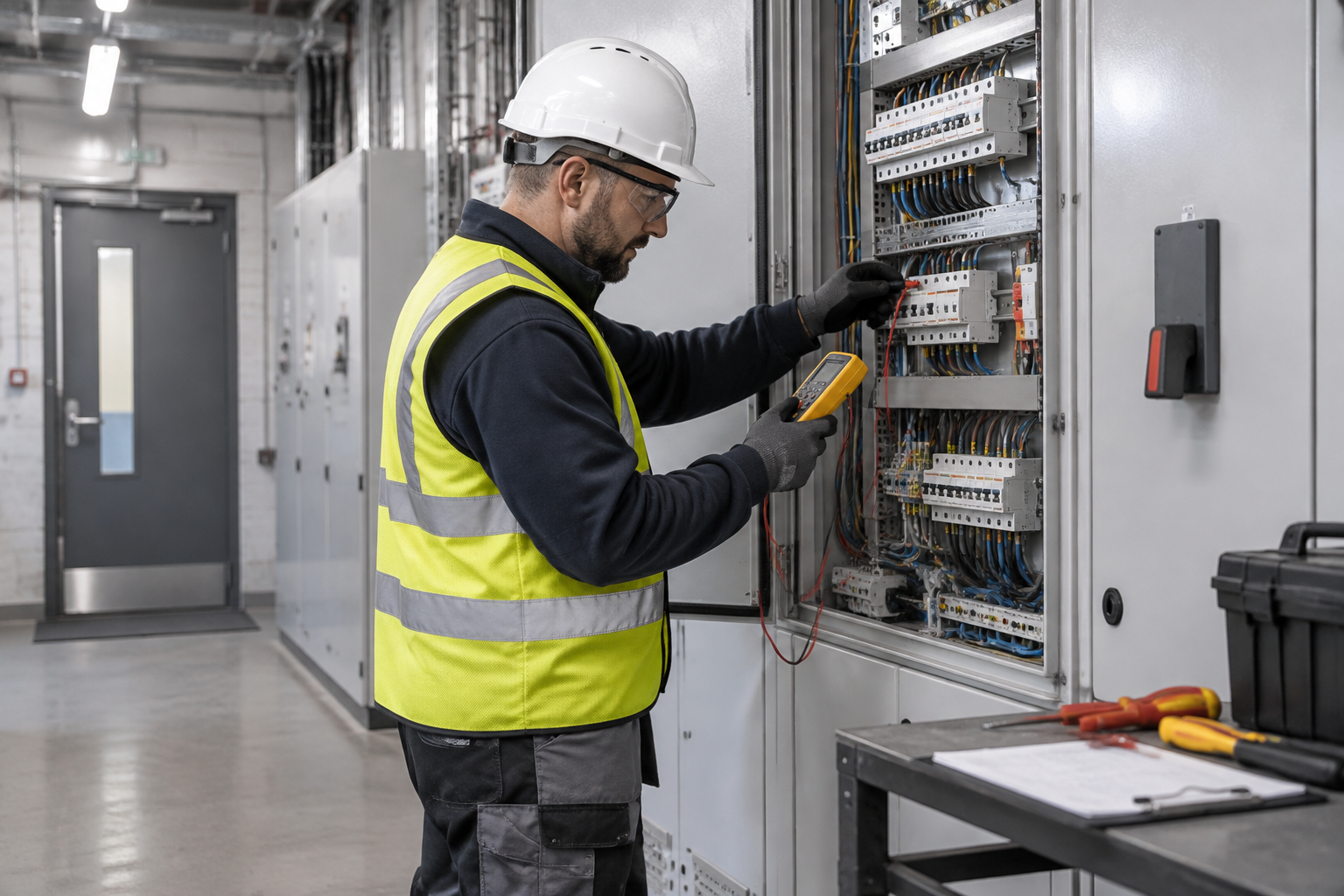
Direct Answer: Commercial and industrial electrical systems generally require formal inspection and testing (an Electrical Installation Condition Report or EICR) every 3 to 5 years, depending on the environment. Commercial offices typically fall on a 5-year cycle, whereas industrial workshops, factories, and high-risk environments often require testing every 1 to 3 years. Final schedules are determined by a competent person based on risk assessment and site conditions under the Electricity at Work Regulations 1989.
For business owners, landlords, and facilities managers across Barnsley and South Yorkshire, keeping electrical installations safe and compliant is a core operational responsibility. A common question arises when planning facility maintenance: how often should commercial and industrial electrical systems be tested? The frequency of testing depends on installation type, environmental conditions, and operational use, guided by a risk-based approach rather than a single universal timeline.
Under the Electricity at Work Regulations 1989, employers and business owners have a legal duty to maintain electrical systems to prevent danger so far as reasonably practicable. While this regulation establishes the ongoing duty to maintain safety, it does not prescribe a universal, mandatory EICR timetable for every site. Instead, safety authorities and industry standards advise that inspection and testing frequencies should be determined by a competent person based on the specific characteristics of the building and its electrical load.
Understanding Commercial and Industrial Inspection Intervals
When planning periodic inspection and testing for business premises, technical guidance such as IET Guidance Note 3 provides indicative starting points. However, these are recommendations rather than rigid legal deadlines. Facilities face vastly different operating environments, meaning an office building requires a different maintenance schedule compared to a heavy manufacturing plant.
The following comparison outlines how different installation types and environments typically approach testing schedules:
| Installation Type / Environment | Commonly Referenced Starting Point | Key Risk Factors Influencing Schedule |
|---|---|---|
| Commercial Offices & Retail Units | Up to 5 years (indicative) | General foot traffic, standard office equipment, dry indoor environment. |
| Industrial Workshops & Factories | Up to 3 years (indicative) | Machinery vibration, dust, moisture, corrosive elements, heavy electrical loads. |
| High-Risk or Special Locations | Annual or more frequent | Flammable atmospheres, wet areas, outdoor installations, high public vulnerability. |
To establish the exact interval for your facility, a competent electrician assesses the condition of the wiring, the age of the consumer units or distribution boards, the environmental wear and tear, and how frequently the system undergoes routine maintenance. Reviewing your previous EICR is often the best starting point, as the inspecting engineer will have recorded a recommended date for the next inspection on the certificate.
How Often Should Commercial Electrical Testing in Barnsley Be Scheduled?
Organisations searching for commercial electrical testing Barnsley often want to know if local environmental conditions alter their testing needs. South Yorkshire has a rich industrial heritage, and many local businesses operate out of converted mills, modern commercial parks, or busy town-centre retail spaces. Each of these settings presents distinct electrical demands.
You should consider scheduling an inspection outside of your usual multi-year timeline if any of the following triggers occur:
- A change of tenancy or a new business acquisition taking over the premises.
- A significant change in the use of the building or the installation of heavy new machinery.
- Frequent tripping of circuit breakers, burning smells, or visible damage to sockets, switches, or distribution boards.
- Alterations, extensions, or major refurbishments to the fixed wiring.
- Following any period where the building has been vacant or subjected to environmental water ingress.
It is important to remember that formal fixed-wire testing is not the same as routine visual checks or Portable Appliance Testing (PAT testing). Routine checks involve staff or maintenance teams looking out for obvious damage day-to-day, while PAT testing focuses specifically on portable appliances plugged into the sockets rather than the building's fixed electrical infrastructure. For more details on business services, explore commercial electrical services and industrial electrical services.
What Happens During a Fixed Installation Inspection?
A professional inspection involves both a thorough visual assessment and dead and live electrical testing of circuits, distribution systems, and protective devices. The engineer inspects for wear and tear, corrosion, thermal damage, and compliance with current safety standards. Once completed, you receive an EICR detailing any observations, classified by codes ranging from urgent dangers (C1 and C2) to recommendations for improvement (C3) or items requiring further investigation (FI).
Working with an experienced local contractor helps minimise operational disruption. Redbrook Electrical Service LTD brings over 20 years of electrical-industry experience to commercial and industrial clients across Barnsley and South Yorkshire, handling inspection, testing, distribution systems, and planned electrical maintenance around your operational hours.
Frequently Asked Questions
Is there a legally fixed testing interval for commercial premises?
No universal statute mandates an exact EICR interval for every commercial building. Instead, the Electricity at Work Regulations 1989 require systems to be maintained safely. Guidance documents provide recommended starting intervals, but the correct frequency for your site must be determined by a competent person based on risk.
Does an EICR cover PAT testing as well?
No. An EICR covers the fixed electrical installation—such as wiring, consumer units, sockets, and fixed lighting circuits. Portable Appliance Testing (PAT) is a separate procedure that assesses moveable electrical equipment and appliances plugged into the system.
Will electrical testing disrupt our business operations?
Testing often requires circuits to be temporarily isolated to carry out dead tests safely. However, a professional contractor can usually schedule these works outside of peak operating hours, overnight, or in phased sections to keep your business running smoothly.
What should I do if defects are found on our inspection report?
If the report highlights C1 or C2 observations, remedial action should be taken promptly to remove potential danger. Your inspecting electrician will provide a clear breakdown of the findings and advise on the necessary repairs to bring the installation back to a safe, compliant standard.
